https://www.sciencedirect.com/science/article/abs/pii/S0304389424018375?via%3Dihub
한국해양과학기술원 김문구 박사님께서 의뢰하신 Graphical abstract가 Journal of Hazardous Materials에 출판되었습니다. 축하드립니다.
Qualitative and quantitative assessment of microplastics derived from antifouling paint in effluent from ship hull hydroblasting and their emission into the marine environment
Taekhyun Kim, Soeun Eo, Won Joon Shim, Moonkoo Kim
Volume 477, 15 September 2024, 135258
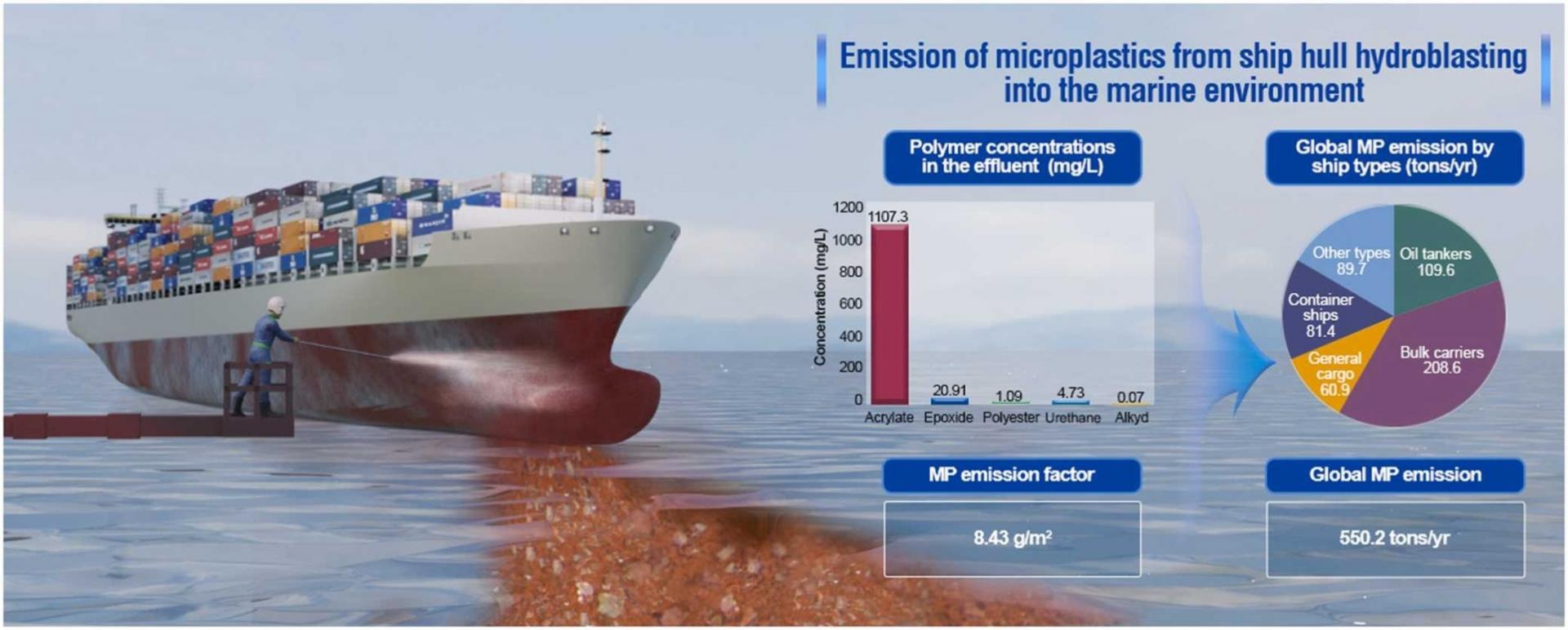
This study focused on microplastic (MP) contamination originating from ship paint, particularly during the hydroblasting of ship hull, to understand the emission characteristics of MPs into the marine environment. We evaluated paint particles generated from the hydroblasting of an ocean-going vessel based on their number, size, polymer type, and mass. Hydroblasting a vessel produced 4.3 × 10¹⁵ particles, predominantly comprising acrylic particles, 99.9 % of which were smaller than 5 mm. Of the 44.1 kg of antifouling (AF) paint particles generated, 36.5 kg consisted of particles smaller than 5 mm, with 18.2 kg being identified as plastic emissions. Furthermore, we calculated the MP emission factor (8.43 g/m2) for hydroblasting on AF paint by dividing the total emission by the wetted surface area (WSA) of the vessel. This factor was then extrapolated by multiplying it with the total WSA of global ships and their hull cleaning frequency to preliminarily estimate the annual global MP emissions. Consequently, a total of 665.6 tons of plastics was generated globally by hydroblasting, with approximately 550.2 tons of these being in the form of MPs. This study highlights the need for developing stricter regulations governing hydroblasting operations and waste disposal practices to protect marine environments from MP pollution.


https://www.sciencedirect.com/science/article/abs/pii/S0304389424018375?via%3Dihub
한국해양과학기술원 김문구 박사님께서 의뢰하신 Graphical abstract가 Journal of Hazardous Materials에 출판되었습니다. 축하드립니다.
Qualitative and quantitative assessment of microplastics derived from antifouling paint in effluent from ship hull hydroblasting and their emission into the marine environment
Taekhyun Kim, Soeun Eo, Won Joon Shim, Moonkoo Kim
Volume 477, 15 September 2024, 135258
This study focused on microplastic (MP) contamination originating from ship paint, particularly during the hydroblasting of ship hull, to understand the emission characteristics of MPs into the marine environment. We evaluated paint particles generated from the hydroblasting of an ocean-going vessel based on their number, size, polymer type, and mass. Hydroblasting a vessel produced 4.3 × 10¹⁵ particles, predominantly comprising acrylic particles, 99.9 % of which were smaller than 5 mm. Of the 44.1 kg of antifouling (AF) paint particles generated, 36.5 kg consisted of particles smaller than 5 mm, with 18.2 kg being identified as plastic emissions. Furthermore, we calculated the MP emission factor (8.43 g/m2) for hydroblasting on AF paint by dividing the total emission by the wetted surface area (WSA) of the vessel. This factor was then extrapolated by multiplying it with the total WSA of global ships and their hull cleaning frequency to preliminarily estimate the annual global MP emissions. Consequently, a total of 665.6 tons of plastics was generated globally by hydroblasting, with approximately 550.2 tons of these being in the form of MPs. This study highlights the need for developing stricter regulations governing hydroblasting operations and waste disposal practices to protect marine environments from MP pollution.